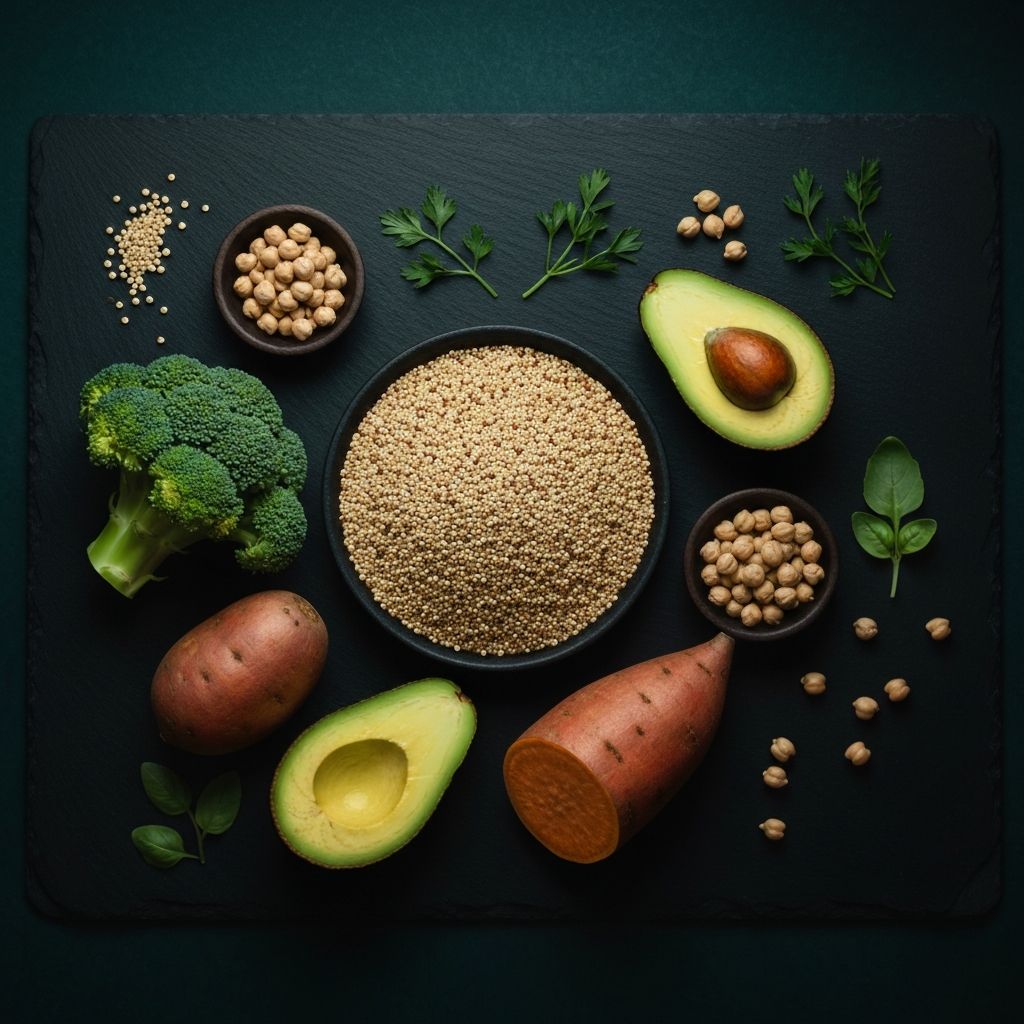
Component 01 — Phytonutrients
Antioxidants and Phytonutrients in Plant Foods
Antioxidants are compounds that can interact with and neutralize free radicals — chemically reactive molecules produced during normal metabolic activity and as a result of environmental factors. The accumulation of free radicals beyond the body's endogenous neutralization capacity is described as oxidative stress, a phenomenon studied in relation to cellular aging and various chronic biological processes.
Plant foods contain a particularly rich array of antioxidant compounds, including vitamins C and E, beta-carotene (a precursor to vitamin A), selenium (a mineral), and a large family of plant-specific compounds collectively termed phytonutrients or phytochemicals. These include polyphenols, flavonoids, carotenoids, lignans, glucosinolates, and many others. Each class of phytonutrient interacts with biological systems in distinct ways and is found in characteristic food sources.
Deeply colored fruits and vegetables — such as berries, dark leafy greens, purple cabbage, red peppers, and orange-fleshed root vegetables — are particularly studied for their phytonutrient density. The color of a plant food often signals the presence of specific antioxidant pigments: anthocyanins in blue and purple foods, carotenoids in orange and red foods, and chlorophyll in green plants. Diverse consumption across colors is consistently emphasized as a way to access the broadest spectrum of these compounds.
Polyphenols
Found in berries, grapes, olives, tea, legumes, and dark chocolate. The largest category of phytonutrients, with thousands of identified compounds.
Carotenoids
Found in carrots, sweet potato, pumpkin, tomatoes, and leafy greens. Include beta-carotene, lycopene, and lutein.
Component 02 — Fatty Acids
Omega-3 and Omega-6 Fatty Acids
Among the dietary fats, polyunsaturated fatty acids occupy a significant position in nutritional research. These are classified into omega-3 and omega-6 families based on the position of their first double bond in the carbon chain. Both families include fatty acids that are considered essential — meaning they cannot be synthesized by the body and must be obtained from food.
The principal omega-3 fatty acids of nutritional relevance are alpha-linolenic acid (ALA), found in plant sources such as flaxseed, chia seeds, walnuts, and hemp seeds; and the long-chain forms eicosapentaenoic acid (EPA) and docosahexaenoic acid (DHA), found predominantly in fatty fish (such as salmon, sardines, mackerel, and herring) and in certain algae. ALA can be partially converted to EPA and DHA within the body, though this conversion is generally limited.
Omega-6 fatty acids, primarily linoleic acid, are found in most vegetable oils, seeds, and nuts. They are necessary for various physiological functions but are consumed in substantially higher quantities in many contemporary dietary patterns relative to omega-3 fatty acids. Nutritional research has examined the ratio of omega-6 to omega-3 consumption as a contextual factor in studying dietary fat patterns across populations.
- Fatty fish: salmon, mackerel, sardines, herring, anchovies
- Plant-based omega-3 sources: flaxseed, chia seeds, walnuts, hemp seeds
- Algae-derived DHA: a marine source independent of fish consumption
- Cold-pressed plant oils: linseed oil as a concentrated ALA source
Component 03 — Gut Microbiome
Probiotics, Prebiotics, and the Gut Microbiome
The gastrointestinal tract is home to a vast and complex community of microorganisms — bacteria, fungi, viruses, and archaea — collectively referred to as the gut microbiome. Numbering in the trillions, these organisms participate in processes including the fermentation of indigestible dietary fiber, the production of certain vitamins (notably some B vitamins and vitamin K), the modulation of the immune system, and the integrity of the intestinal barrier.
Probiotics are live microorganisms that, when present in the gut in adequate quantities, are associated with a favorable composition of the gut microbial community. They are naturally found in fermented foods such as plain yogurt, kefir, naturally fermented sauerkraut, miso, kimchi, and kombucha. Different strains of microorganisms confer different effects, and research in this area is an active and evolving field.
Prebiotics are dietary components — primarily non-digestible carbohydrates such as inulin, fructooligosaccharides, and resistant starch — that serve as substrates for beneficial gut bacteria. They are found in foods such as garlic, onions, leeks, asparagus, bananas, oats, barley, and legumes. Dietary patterns rich in diverse plant foods naturally provide a broad range of prebiotic substrates, supporting a more diverse and resilient gut microbial community.
- Plain yogurt
- Kefir
- Sauerkraut
- Kimchi
- Miso
- Tempeh
- Kombucha
- Naturally pickled vegetables
Component 04 — Whole Grains
Whole Grains: Structure and Nutritional Significance
A grain kernel in its whole, unprocessed form consists of three anatomical components: the outer bran layer, the inner germ, and the starchy endosperm. Each layer contributes distinct nutritional compounds. The bran contains dietary fiber, B vitamins, and minerals including iron, zinc, and magnesium. The germ is rich in vitamin E, B vitamins, healthy fats, and antioxidants. The endosperm provides primarily starch and a smaller proportion of protein.
Refined grain products — such as white flour and white rice — are produced by milling that removes the bran and germ, retaining primarily the starchy endosperm. This process reduces the content of fiber, vitamins, minerals, and phytonutrients relative to the whole grain form. Whole grain versions of staple foods such as bread, pasta, rice, oats, and cereals retain all three grain components.
Examples of whole grains recognized across nutritional frameworks include oats, brown rice, whole wheat, barley, rye, quinoa (technically a seed), bulgur, farro, millet, and sorghum. Nutritional guidelines from multiple countries consistently position whole grains as preferable to refined alternatives within varied dietary patterns.
Component 05 — Legumes
Legumes and Pulses: Nutritional Composition
Legumes are the edible seeds of plants belonging to the Fabaceae family and represent one of the most nutritionally dense food categories available. They are exceptional among plant foods for their protein content, providing a range of essential amino acids, though most legumes have relatively lower levels of methionine compared with animal proteins. When consumed alongside other plant protein sources (such as whole grains), the overall amino acid profile is complemented effectively.
Beyond protein, legumes are rich in complex carbohydrates, dietary fiber (both soluble and insoluble), folate, iron, potassium, magnesium, and zinc. They contain resistant starch — a type of carbohydrate that escapes digestion in the small intestine and reaches the colon, where it serves as a prebiotic substrate for gut bacteria. Legumes also contain various phytonutrients including isoflavones, lignans, and phenolic acids.
Common legume categories include dried beans (kidney, black, navy, pinto, cannellini), lentils (green, red, brown, black), chickpeas (garbanzo beans), split peas, broad beans (fava), and soybeans. The latter is the source of derived foods including tofu, tempeh, miso, and edamame. Legumes feature prominently in traditional dietary patterns across the Mediterranean, Middle East, South Asia, and Latin America.
Component 06 — Dietary Patterns
Dietary Diversity and Pattern-Level Thinking
A central concept in contemporary nutritional science is the shift from examining individual nutrients in isolation to studying dietary patterns as a whole. No single nutrient, food, or food group can represent the full complexity of a healthy diet. The cumulative effect of many foods consumed regularly over time — the overall dietary pattern — is the primary unit of analysis in much modern epidemiological nutrition research.
Dietary patterns that have been broadly studied in association with favorable long-term population health outcomes share several structural characteristics: they are predominantly plant-based; they include a wide variety of fruits, vegetables, whole grains, legumes, nuts, and seeds; they use minimally processed ingredients; they include healthy fat sources such as olive oil or other cold-pressed plant oils; and they are relatively low in refined carbohydrates, added sugars, and highly processed packaged foods.
Cultural and regional variations in these patterns — the Mediterranean dietary tradition, traditional East Asian plant-rich cooking, and the dietary habits of populations in regions of noted longevity — share many of these structural characteristics despite differing significantly in their specific foods, flavors, and culinary practices. This convergence across distinct cultures suggests that the underlying nutritional principles are broader than any single regional cuisine.
1
Predominance of plant-based whole foods across the daily dietary pattern
2
Variety across and within food categories to access a broad spectrum of nutrients and phytonutrients
3
Minimal processing of the majority of foods consumed on a regular basis
4
Adequate hydration from water and water-containing foods as an integral part of the daily pattern
Component 07 — Minerals in Depth
Trace Minerals and Their Dietary Contexts
While major minerals such as calcium and iron receive significant attention in nutritional education, trace minerals — required in smaller quantities but equally essential — form a broader and often less discussed aspect of dietary composition. These include zinc, selenium, copper, manganese, iodine, chromium, and fluoride.
Zinc is involved in over 300 enzymatic reactions and plays roles in cellular division, wound healing, and immune system function. It is found in oysters and shellfish, red meat, poultry, legumes, pumpkin seeds, and fortified cereals. Selenium functions as a cofactor for a family of antioxidant enzymes called selenoproteins and is found in particularly high concentrations in Brazil nuts, as well as in fish, poultry, and whole grains grown in selenium-rich soils. Copper participates in iron metabolism, connective tissue formation, and neurological function, and is found in organ meats, shellfish, nuts, and seeds.
Iodine is an essential component of thyroid hormones, which regulate metabolic rate. Its primary dietary sources include iodized salt, marine fish, seaweed, and dairy products. The availability of iodine in plant foods varies significantly by the iodine content of the soil in which they are grown. Manganese is involved in bone formation and the metabolism of carbohydrates and amino acids, and is found in whole grains, legumes, nuts, and leafy vegetables.
Component 08 — Carbohydrate Quality
Carbohydrate Quality: Fiber, Starch, and Glycemic Characteristics
Not all carbohydrate-containing foods behave identically in the body. The rate at which a food raises blood glucose levels after consumption — a concept represented by the glycemic index (GI) — varies considerably between carbohydrate sources. High-GI foods such as white bread and sugary drinks are rapidly digested and produce a swift rise in blood glucose, followed by a corresponding fall. Low-GI foods such as legumes, oats, and most whole fruits are digested more gradually, producing a more moderate and sustained release of glucose.
Several factors influence a food's glycemic characteristics: the type and structure of starch present (amylose vs. amylopectin), the fiber content, the presence of acids (as in sourdough fermentation), the degree of processing, the method and duration of cooking, and whether the food is consumed as part of a mixed meal. These variables mean that glycemic index alone is a limited tool, and nutritional research often considers glycemic load — which accounts for both the GI and the quantity of carbohydrate in a serving — as a more contextually relevant measure.
Resistant starch, a form of starch that is not digested in the small intestine, is a nutritionally significant concept. Found in raw or cooked and cooled starchy foods (such as green bananas, cooled cooked potatoes, and legumes), resistant starch passes to the colon where it is fermented by gut bacteria and acts as a prebiotic fiber. It contributes to gut microbiome diversity and produces short-chain fatty acids as fermentation byproducts.